
.png)

.webp)
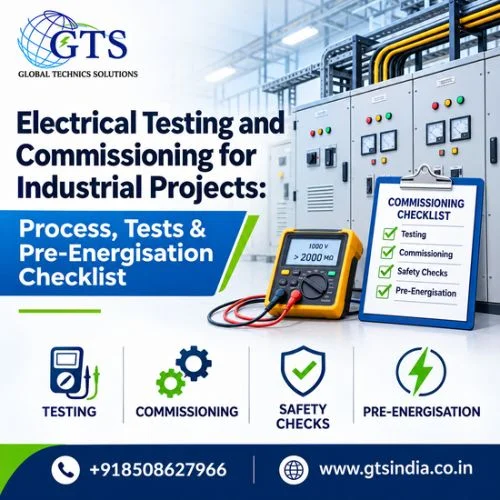
The scope may include transformers, HT and LT panels, vacuum circuit breakers (VCBs), distribution boards, cables and protection systems. A planned electrical testing and commissioning programme defines the tests, responsibilities and acceptance criteria for each stage.
Why Are Testing and Commissioning Important for Industrial Projects?
Industrial facilities depend on a stable electrical supply to run machinery, production lines, pumps, motors and control systems. A loose connection, insulation fault or incorrect protection setting can lead to equipment damage, unexpected shutdowns or safety risks.
Planned testing helps identify these issues before the system is put into service. It also provides documented results for the project team to review before handover. Electrical testing and commissioning services can support this process by checking that installed equipment is ready for operation.
Pre-Commissioning Inspection and Preparation
Before individual tests begin, the team reviews approved drawings, equipment details, cable schedules and test procedures. A visual electrical system inspection checks for visible damage, correct equipment ratings, cable identification, secure terminations, clearances and proper labelling.
Equipment is isolated and confirmed de-energised before tests that require it. Stored energy and possible back-feed sources must be considered. Authorised personnel should use suitable, calibrated instruments and follow the site's approved safety procedures.
A practical pre-energisation checklist includes:
- Approved drawings, equipment schedules and test procedures are available.
- Panels, transformers and cables match the approved specifications.
- Terminations, busbar joints, labels and mechanical supports have been checked.
- Earthing connections and protective devices have been inspected.
- Test instruments have valid calibration records.
- Test results, defects and corrective actions are documented.
- Required client inspections and approvals are complete.
HT Electrical Equipment Testing
High-tension electrical equipment testing requires a test plan that considers the equipment's voltage rating, design and operating conditions. HT LT electrical testing may include insulation resistance measurements, contact resistance checks, circuit-breaker operation tests, protection relay testing and control-circuit verification, depending on the equipment.
The team may also check interlocks, trip circuits, indications and protection coordination. Test results are compared with approved limits, manufacturer recommendations and applicable standards. The exact scope should be confirmed in the project test schedule.
LT Panel and Distribution Board Testing
For LT panels and distribution boards, inspection covers panel ratings, busbar connections, cable terminations, phase identification, protective devices and clearances. Insulation resistance and continuity tests are carried out where applicable, followed by polarity, phase-sequence and functional checks.
Circuit breakers, meters, indication lamps, control wiring and interlocks are checked against approved drawings. These activities form part of electrical installation testing and help confirm that the distribution system is ready for controlled operation.
Transformer and VCB Testing
Transformer tests may include insulation resistance, winding resistance, voltage ratio, vector group and tap-changer operation checks, depending on the transformer type and project requirements. The team also inspects oil condition, leakage, accessories, alarms and protective devices where relevant.
For a VCB, the test scope may cover insulation, contact resistance, opening and closing operation, timing, trip-circuit health, mechanical interlocks and associated protection relays. The approved test plan and manufacturer’s instructions determine which tests are required.
Cable Insulation and Continuity Testing
Power and control cables are checked for correct identification, routing, support, termination and phase marking. Continuity tests confirm that conductors follow the intended path, while insulation resistance tests help identify weaknesses between conductors and earth.
The test voltage and method must be suitable for the cable type and rating. Results should be recorded against each circuit reference so that any fault can be traced, corrected and retested before the next stage.
Earthing System and Electrical Safety Checks
The earthing system provides a path for fault current and supports the operation of protective devices. Checks may include earth connections, protective-conductor continuity, bonding and specified earth resistance measurements.
Equipment bodies, panels and transformer structures must be connected to the designed earthing network. Readings are assessed against the project design, applicable standards and acceptance criteria.
Electrical System Energisation and Final Commissioning
The system should move to energisation only after required tests have passed, defects have been closed, reports have been reviewed and the responsible project authorities have given clearance. Before switching, the team confirms that tools, temporary earths and test leads are removed, covers are secured, protection settings are approved and personnel are clear.
Power is introduced in the sequence set out in the approved switching procedure. Voltage, phase sequence, indications, alarms and equipment behaviour are monitored. Any abnormal sound, smell, vibration, trip or unexpected reading requires investigation before operation continues. The electrical commissioning process should follow the approved project sequence, with each stage documented and reviewed before moving to the next.
Why Choose an Experienced Electrical Testing and Commissioning Contractor?
Industrial projects involve coordination between designers, installers, equipment suppliers and the client. An experienced contractor can plan tests, coordinate access, maintain records and arrange corrective work when issues are found. This is particularly useful for industrial electrical commissioning, where several systems must work together.
GTS India provides HT and LT contracting, testing, commissioning, installation and maintenance support. The company holds an A Grade Electrical Contractor licence (EA: 3034) and has more than 42 years of experience. Learn more about its work as an electrical contractor in Chennai.
GTS India is also an electrical contracting company in Tamil Nadu and offers an industrial electrical maintenance service.
For coordinated project execution, a turnkey electrical contractor in Chennai can manage connected stages under an agreed scope.
Frequently Asked Questions
1. When should electrical testing be carried out in an industrial project?
Testing is carried out at relevant installation stages and before energisation. The timing and sequence depend on the equipment, project specifications and approved test plan.
2. What is included in HT and LT electrical testing?
The scope may include insulation resistance, continuity, earthing, circuit-breaker operation, relay checks and functional tests. Requirements vary by equipment and system design.
3. Why is insulation resistance testing important?
It helps identify deterioration, moisture or damage in insulation before a circuit is put into service. Results must be assessed against the correct equipment and test criteria.
4. Can a system be energised if one test has failed?
A failed or inconclusive test must be investigated and resolved under the approved procedure. Energisation should wait until required acceptance checks and clearances are complete.
5. What documents are needed after commissioning?
Handover records typically include test reports, inspection checklists, approved drawings, equipment details, protection settings and records of corrective work. The final list depends on the contract and applicable requirements.